Most keratoconus patients hit the same moment: their regular soft contacts stop working. The prescription keeps shifting, the vision blurs unpredictably, and eventually their optometrist says it’s time to move to specialty lenses. That’s the right call — but it’s also when costs escalate sharply. Specialty keratoconus lenses don’t come close to the price of standard soft contacts, and understanding what drives the differences will help you make smarter choices.
Here’s what each lens type costs and when each one makes sense.
Specialty Lens Costs by Type
Keratoconus requires rigid or semi-rigid lenses because the irregular corneal surface can’t be properly corrected with soft lenses that simply drape over the distortion. The lens options span a wide cost range:
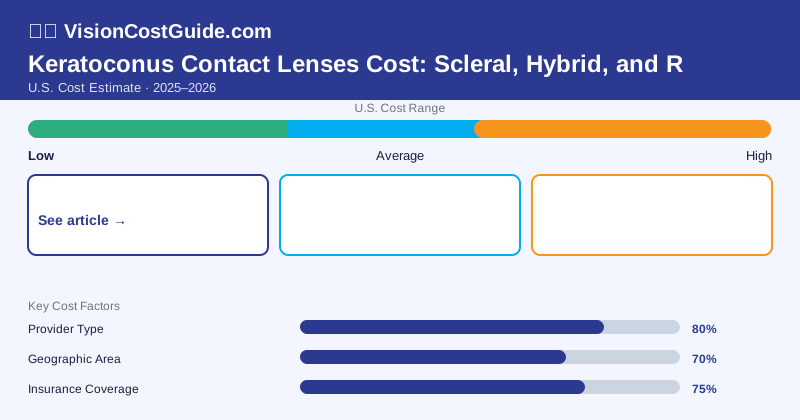
| Lens Type | Cost Per Lens | Annual Pair Cost | Best For |
|---|---|---|---|
| Rigid Gas Permeable (RGP) | $100–$300 | $200–$600 | Mild to moderate KC, experienced wearers |
| Hybrid (soft skirt + rigid center) | $250–$500 | $500–$1,000 | Moderate KC, comfort-sensitive patients |
| Scleral lenses (15–18mm) | $700–$2,000 | $1,400–$4,000 | Moderate to severe KC, dry eye co-morbidity |
| Mini-scleral (13–15mm) | $500–$1,500 | $1,000–$3,000 | Mid-range option between corneal and full scleral |
| Fitting fees (per eye) | $200–$600 | — | Included in some practices, separate in others |
The fitting fee is a real and often separate cost — keratoconus fits are complex. Your optometrist may go through 3–8 trial lenses per eye before arriving at the final parameters, and that takes time. Some practices bundle fitting into the lens cost; others bill it separately. Ask upfront.
Why Scleral Lenses Cost the Most
Scleral lenses vault over the entire cornea and rest on the sclera (the white part of your eye), creating a smooth liquid reservoir between the lens and the irregular corneal surface. That reservoir is filled with sterile saline every time you insert the lens. The result is dramatically better optics for distorted corneas — and dramatically better comfort for people who also have dry eye, which is common in keratoconus patients.
The high cost reflects custom manufacturing. Each scleral lens is made to order based on a detailed map of your eye’s surface (corneal topography), and adjustments are common even after the initial fit. Materials are also more expensive — scleral lenses use highly oxygen-permeable polymers to allow adequate oxygen transmission across their larger diameter.
NEI researchers note that keratoconus affects approximately 1 in 2,000 Americans and typically progresses through young adulthood, stabilizing in the mid-30s to 40s. That means most patients face decades of ongoing lens costs — making the per-year math important.
Specialty contact lenses for keratoconus are medically necessary, not cosmetic — and that distinction matters enormously for coverage. Several important coverage pathways:
- Medical insurance: Many plans cover specialty lenses for keratoconus under the medical benefit (not the vision benefit). Document the diagnosis and a letter of medical necessity from your ophthalmologist. Success rates vary by plan, but it’s worth pursuing.
- VSP Signature Plan: Covers specialty contact lenses for keratoconus up to a specific benefit allowance — check your plan’s “contact lens benefit for irregular corneas” provision.
- EyeMed: Similar specialty lens provisions in select plans.
- Corneal disease foundations: The National Keratoconus Foundation maintains a list of manufacturer assistance programs and fitting grants. Worth checking before paying full retail.
Always get a letter of medical necessity. Without it, insurers will treat the lenses as elective.
The Scleral Lens vs. Corneal Cross-Linking Decision
If your keratoconus is still progressing, your ophthalmologist may recommend corneal cross-linking (CXL) to halt the progression. CXL costs $2,500–$4,000 per eye — a one-time surgical cost — versus ongoing specialty lens expenses that accumulate over time. The two aren’t mutually exclusive: many patients have CXL to stop progression and still need specialty lenses afterward. But if you’re still in the progression phase, prioritize stopping it before optimizing the optical correction.
The AOA recommends that keratoconus patients have corneal topography mapping at least annually to track progression. That topography data is also what your fitter uses to dial in scleral lens parameters, so it serves double duty.
Managing Long-Term Costs
Scleral lenses typically last 1–3 years with proper care. Key cost-reduction strategies:
- Use the manufacturer’s cleaning system as directed — contamination is a leading cause of premature lens degradation
- Store in appropriate cases with fresh solution daily — not tap water
- Get a backup pair if your prescription is stable — some labs discount second pairs
- Ask about manufacturer lens replacement warranties if a lens cracks or warps within the first year
Don’t order keratoconus specialty lenses from a discount online retailer. Unlike standard soft lens prescriptions, keratoconus lens parameters require in-person fitting with corneal topography and multiple trial fits. An incorrectly fit scleral lens can cause corneal hypoxia, scarring progression, or simply fail to provide usable vision. There’s no legitimate shortcut on the fitting process.
Bottom Line
Keratoconus specialty lenses cost $500–$4,000+ per pair annually, with scleral lenses at the high end providing the best vision quality for advanced cases. Insurance coverage is more available than most patients realize — pursue the medical necessity route through your health insurance, not just your vision plan. And if you’re still in the progression phase, get the cross-linking conversation on the table before you’re spending $3,000/year on lenses indefinitely.