About 4% of Americans have strabismus — crossed or misaligned eyes — making it one of the most common eye conditions in the country, according to the American Academy of Ophthalmology. Most cases begin in early childhood, but adults can develop strabismus after stroke, head injury, or as a complication of other eye surgery. The surgical fix? It works. But the cost story is completely different depending on whether the patient is a child or an adult.
Surgery Cost Breakdown
Strabismus surgery adjusts the tension of the extraocular muscles — the six muscles that control each eye’s movement — to realign the eyes. It’s typically outpatient surgery under general anesthesia for kids and monitored anesthesia care (MAC) for cooperative adults.
| Cost Component | Typical Range |
|---|---|
| Surgeon fee (per muscle procedure) | $1,500–$3,500 |
| Facility/ASC fee | $2,000–$5,000 |
| Anesthesia | $500–$1,500 |
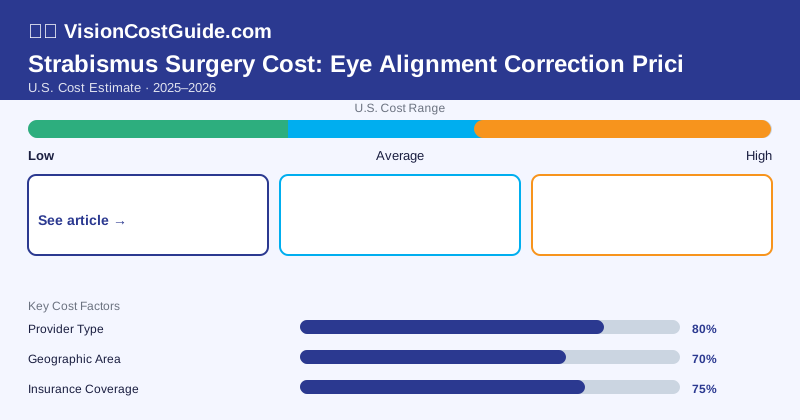
| Total per procedure (one session) | $4,000–$10,000 |
| Adjustable suture surcharge (adults) | $500–$1,000 additional |
| Second procedure (if needed) | Same cost range |
Adjustable suture surgery — an option for adult patients who can cooperate with post-op fine-tuning while awake — lets the surgeon tweak muscle tension after anesthesia wears off. That extra precision costs $500–$1,000 more, but it tends to improve single-surgery success rates. Worth asking about if you’re an adult candidate.
Children vs. Adults: Very Different Insurance Stories
Children: Health insurance — both commercial plans and Medicaid — generally covers strabismus surgery as medically necessary for kids. Misaligned eyes disrupt binocular vision development and depth perception, and they’re the leading cause of amblyopia in children. Insurers recognize those functional stakes. Prior authorization is usually routine.
Adults: Adult strabismus is messier from a coverage standpoint. Some insurers classify it as cosmetic when diplopia (double vision) isn’t present — even though research consistently documents the social and occupational consequences of misalignment. The AAO has published position papers arguing that adult strabismus surgery deserves functional coverage based on quality-of-life impact, but not every insurer agrees.
Adults whose strabismus traces back to thyroid eye disease, stroke, or trauma generally have the strongest documentation for medical necessity and fare better in prior auth reviews than adults with long-standing childhood strabismus seeking correction later in life.
To improve approval odds for adult strabismus surgery:
- Document diplopia (double vision) if present — this is the strongest functional indicator
- Include visual field testing showing field loss from the deviation
- Include documentation of functional impairment (reading difficulty, driving limitations, workplace impact)
- Have your ophthalmologist write a detailed letter of medical necessity citing the functional — not cosmetic — nature of the procedure
- Appeal denials with additional peer-reviewed literature — appeal success rates for strabismus surgery are meaningfully higher than for many other elective procedures
Botulinum Toxin Injection: The Non-Surgical Alternative
For certain types of strabismus — small-angle deviations and recently developed adult cases in particular — botulinum toxin (Botox) injected into the extraocular muscle can restore alignment temporarily or even semi-permanently. The effect typically lasts 2–4 months initially, but repeated injections sometimes produce more durable results.
Cost per injection runs $500–$1,500 including the physician fee. Medical insurance sometimes covers it when the indication is clearly documented. If you’re trying to avoid surgery or delay it, botulinum toxin is worth a conversation with a strabismus specialist.
Prism Glasses: The Conservative Option
Small strabismus deviations causing diplopia can often be managed with prism lenses ground into glasses. Prism correction adds $50–$200 to eyeglass costs depending on the prism power needed. It doesn’t fix the underlying misalignment — but for many patients, eliminating double vision without surgery is exactly what they need.
Strabismus surgery has a reoperation rate of 20–30% — meaning roughly 1 in 4 patients needs a second procedure to hit the target alignment. That’s not a sign of surgical failure. Muscle response varies between individuals and isn’t perfectly predictable. Talk to your surgeon before the first procedure so a potential second surgery doesn’t catch you off guard financially. Building that possibility into your budget from the start is smart planning.
Amblyopia and Strabismus: The Linked Relationship
Strabismus and amblyopia often travel together. A turned eye is the single most common cause of amblyopia in children — strabismic amblyopia. Treating the strabismus may be necessary to support amblyopia treatment, and amblyopia treatment often improves surgical outcomes. For full costs of amblyopia treatment, see our amblyopia treatment cost guide.
Bottom Line
Strabismus surgery runs $4,000–$10,000 per procedure. Children have strong insurance coverage. Adults face variable coverage that depends heavily on whether diplopia is present, the underlying diagnosis, and the insurer’s policies. Budget for a potential second surgery — 20–30% of patients need one. Botulinum toxin injection ($500–$1,500) is a non-surgical option for appropriate candidates, and prism glasses offer conservative management for small deviations. If you’re an adult facing an initial denial, investing time in a solid medical necessity appeal is usually worthwhile.